LIZ BEVAN CONTENT DESIGNER
Taxonomy, templates, and systems thinking
tl;dr I rearchitected Sun Life’s disability claims flow and Meta’s developer platforms by translating complex compliance requirements into intuitive information architectures. Utilizing scalable taxonomies, structured templates, and centralized terminology governance, I streamlined high-friction user journeys to reduce system complexity and lower customer support volume.
Sun Life's first mobile style guide & empathy framework
-
Used user research and customer care insights to resolve complex language, complicated, highly legislated concepts, and fill personalization gaps across transactional, logged-in experiences.
-
Authored a comprehensive mobile app style guide based on the Canadian Press Style Guide, establishing rules to simplify dense legal, policy, and legislative terminology.
-
Created a scenario-based tone and empathy framework with integrated accessibility standards, guiding standards for bad news, policy shifts, milestones, and more.
-
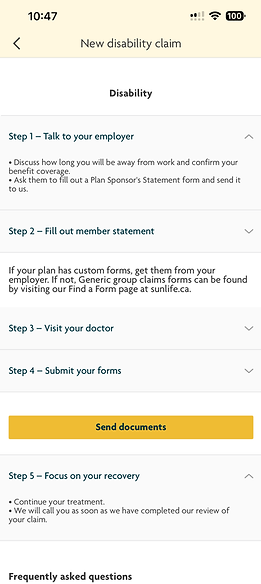
Introduced empathy to claim submission flows (see screenshot), telling the submitter to "focus on your recovery" as part of the disability claims process, a previously complicated, impersonal, analog process.
-
Required FAQs in flow, keeping pertinent information in proximity to action.
-
Framework and content still in use 6 years later.
-
-
Led a team of three UX writers in an initiative to operationalize these new empathy standards across customer touchpoints.
-
Overhauled approximately 500 impersonal form letters into supportive, humanized communications by introducing agent signatures and a clear, helpful tone.
-
-
High impact work:
-
Reduced form completion drop-off rates by 42% across the website.
-
Decreased average submission time from over an hour to under 20 minutes.
-
Lowered customer support inquiries regarding form ambiguity by 35%.
-
Cross-platform term audit and IA alignment
-
Audited terminology and information architecture discrepancies across five Meta developer centers: Social Technologies, Horizon, Wearables, Llama, and AI.
-
Identified 70+ overlapping concepts across all centers, isolating the top 17 high-risk discrepancies causing developer confusion.
-
-
Partnered with product teams to eliminate siloed language and stop "shipping the org chart," aligning concepts across related product experiences.
-
Standardized contradictory UI terms across platforms. For example, resolving varying home page names (Home vs. Dashboard vs. My Apps) into a unified concept of "Home."
-
Disambiguated conflicting features, such as Required Actions, separating critical, access-breaking alerts from less severe notifications by renaming Horizon's feature to "Tasks."
-
Spearheaded an initiative to align top and left navigation layouts, documentation hierarchies, and interface elements like standardizing on a notification bell icon.
Example
Before: navigation was made up of fragmented information architecture across developer centers causing unnecessary confusion. It was clear different teams were working on each developer center.


After: A mock-up of the proposed navigation shipping in 2026. This design standardizes the top bar with global features (Search, Home, Docs, Team, Notifications, Profile) and moves center-specific tools to a project-scoped left navigation.

Other taxonomy, style, and systems work
-
Created a wiki-based style guide and template system to standardize compliance messaging, requiring clear policy links, specific violation triggers, and actionable fix steps to guide future project work.
-
Implemented style guide for Meta’s App Review compliance messaging by leading a x-functional rewrite of over 200 common responses, helping developers retain or regain data access with minimal friction.
-
-
Spearheaded end-to-end creation of the dev platform-wide "How to write a use case" style guide serving as a resource for future project work to drive consistency and clarity.
-
Partnered with product, legal, and policy teams to establish strict requirements, including dev-focused verb-based titles, mandatory product integration names, plain-language descriptions, and explicit mentions of unique requirements. Read more about this project here.
-
-
Term lead and reviewer for Reality Labs: Governed the strategy, tracking, and quality requirements for new product vocabulary added to Acrolinx.
-
Led a cross-functional project to streamline the database taxonomy, aligning internal terminology with developer platform structures and scoped concept audits.
-